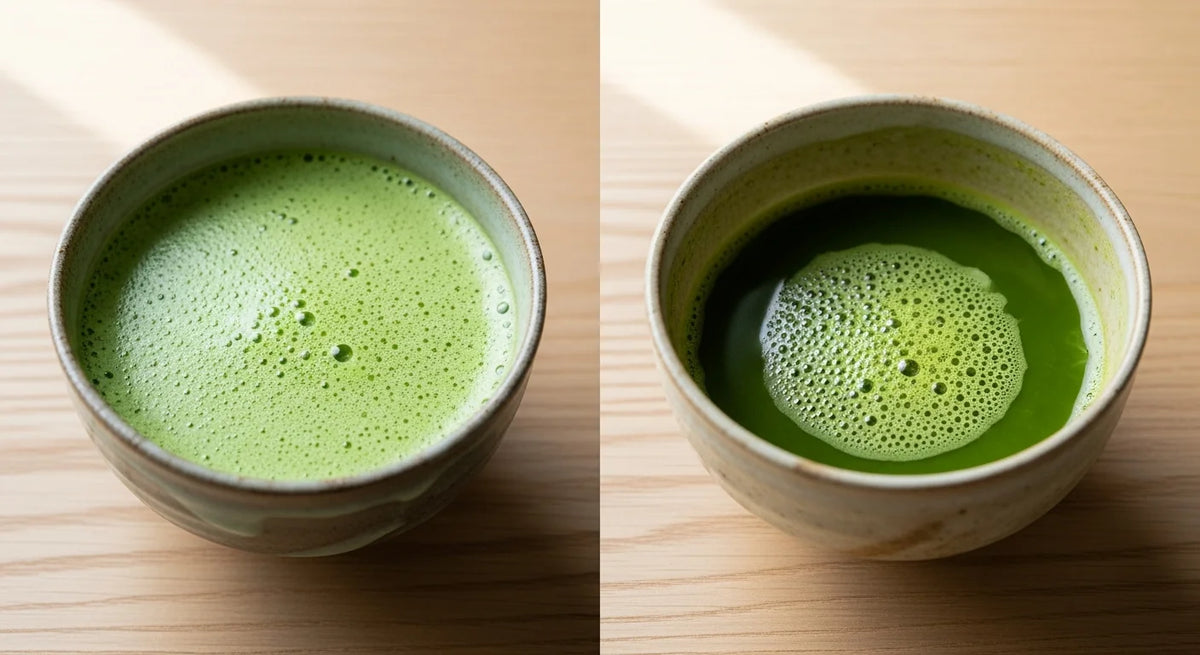

The green arrives first. Bright, almost wet-looking. Then the scent rises from the bowl, marine and sweet, with a little warmth from the steam. A quick movement of bamboo. A fine layer of foam. If you have been wondering how to make Matcha at home, this is the part that makes people pause and think it must be difficult.
It is not. Making Matcha at home is simpler than it looks. Once you know the bowl, the water, and the motion of the whisk, the whole ritual becomes calm and practical. Our team returns to the same basics again and again: sift well, keep the water around 80°C (175°F), and whisk with the wrist, not the shoulder. Color, aroma, texture. The rest follows.
What you need to make Matcha
Learning how to prepare Matcha starts with tools, not technique. Good tools do not have to be expensive, but they do need to suit the tea. Matcha is a fine powder, and small differences in bowl shape or whisk design show up quickly in the cup.
The essentials — whisk, bowl, sifter
The first tool is the chasen, a bamboo whisk made for Matcha. Bamboo matters here. It flexes easily, moves through the liquid with very little resistance, and creates many small bubbles instead of a few large ones. A metal whisk or milk frother can mix Matcha, but the foam is usually rougher, the movement is harsher, and the bowl feels less controlled. If you do not own a whisk yet, this is the one piece worth buying first. For a deeper look at choosing the right whisk, bowl, and accessories, see our Matcha tools guide.
Next comes the chawan, the Matcha bowl. A wide mouth gives you room to whisk in quick back-and-forth strokes, and a curved bottom helps gather the powder and water into one smooth suspension. Narrow cups make the motion cramped. The whisk hits the sides too easily. For beginners, that wider bowl makes a visible difference.
A fine-mesh sifter matters just as much. Matcha clumps as soon as it meets humidity, even inside a sealed tin, so sifting is less about formality than texture. Smooth Matcha almost always begins with sifted powder. A chashaku, the bamboo scoop used in tea practice, is optional. It is pleasant to use and easy to gauge by feel, but a teaspoon works perfectly well at home.
Choosing a chasen — why the number of tines matters
Not all bamboo whisks behave the same way. An 80-tine chasen, often called hachijuppondate, is the standard middle ground. It gives you enough flexibility to make fine foam, but it still feels steady in the hand. Our team often recommends it for daily use because it handles ordinary usucha well without becoming too delicate.
A 100-tine whisk makes even finer foam and can feel easier for beginners who are still learning how to whisk Matcha. More tines mean more contact with the liquid, so the bubbles tend to come together a little faster. A coarse-tine whisk, sometimes called kazuho, is different again. It has fewer, stiffer tines and is meant for koicha, where you knead the Matcha into a thick, glossy bowl rather than whipping in air.
The whisk should also match the powder. If you are choosing tea for your first bowls, our guide to Ceremonial Grade Matcha explains what to look for in Matcha that is meant to be whisked and drunk straight.
How to make usucha — the everyday cup

For most people, how to make Matcha tea really means how to make usucha, the thin style of Matcha prepared for daily drinking. It is light enough to sip easily, but still full of color and aroma. The process is short. The order matters.
Warm the bowl, soften the whisk
Start by pouring hot water into the bowl. Set the whisk into that water for about 30 seconds so the tines can soften and open slightly. Dry bamboo is more brittle, and a whisk used straight from the shelf is easier to crack or split. This short soak protects the whisk and makes the first strokes feel smoother.
Then discard the water and wipe the bowl dry. It is a small step, but worth doing. Extra water left in the bowl changes the ratio, thins the tea, and makes the result less precise from the first sip.
Sift the Matcha
Sift 2 grams of Matcha into the warm bowl. That is about 1.5 scoops of a chashaku, or roughly 1/2 teaspoon. Even fresh Matcha tends to gather into small lumps, and those lumps do not dissolve cleanly once water is added. They sit in the bowl, then show up on the tongue.
Sifting breaks the powder back into a soft, even mound. The tea blends faster, the surface looks cleaner, and the final bowl tastes smoother. If someone asks our team how to prepare Matcha with the fewest mistakes, we usually start here. Always sift.
Add water at the right temperature
Add about 2 to 2.5 ounces of water, or 60 to 70 mL, at 80°C (175°F). Not boiling. If your kettle has just come to a full boil, pour the water into another cup first and let it cool for a moment before adding it to the bowl. That small drop in temperature changes the taste more than many people expect.
At lower temperatures, theanine, the amino acid behind Matcha's umami and sweetness, dissolves readily. Push the temperature too high and catechin extraction becomes much more assertive, which brings sharper bitterness and astringency. Around 80°C (175°F), the balance stays gentle. Our article on temperature and tea flavor goes deeper into why the cup shifts so much with only a few degrees.
Whisk in a "W" motion
Hold the whisk upright, with the tips just off the bottom of the bowl. Then move your wrist in quick back-and-forth strokes, as if you were drawing a narrow "W" or "M" across the center. The motion is light and fast. Mostly wrist. Hardly any arm.
Whisk for about 15 to 20 seconds. You should see a layer of fine foam begin to gather across the surface. This is the part many beginners overcomplicate, but it is straightforward once you feel the rhythm. Matcha is not frothed by stirring in circles. Straight-line motion pushes air into the liquid. Circular motion mostly moves the tea around.
If you have ever searched for how to whisk Matcha and found contradictory advice, this is the point to trust. Keep the whisk off the bowl's bottom. Stay in quick, narrow strokes. Let the bubbles build themselves.
Lift and finish
When the foam looks even, slow your hand and skim gently across the surface to smooth out any large bubbles. Then lift the whisk from the center of the bowl. A small peak of foam in the middle is a good sign. Not showy. Just tidy and alive.
Drink the bowl soon after whisking. Matcha settles as it sits, and the texture is best in the first moments, while the foam is still fine and the aroma still rising from the heat.


How to make koicha — thick Matcha, the ceremonial way
Koicha is the concentrated side of Matcha. Less airy, more deliberate. Instead of a light, foamy bowl, you make something dense and glossy, almost like melted chocolate in texture. The usual ratio is 4 grams of Matcha to about 1 to 1.5 ounces of water, or 30 to 40 mL, still at around 80°C (175°F).
The movement changes too. Do not whisk quickly and do not aim for foam. Use the whisk to knead the Matcha slowly in a circular motion, often described as tracing the Japanese character "no" の. The goal is to gather the powder and water into a smooth, thick liquid with no roughness and no bubbles breaking the surface.
Because there is so little water, koicha leaves nowhere to hide. Lower-grade Matcha turns bitter fast at this concentration, which is why koicha demands a high-grade powder with depth, sweetness, and very low harshness. If you want a clearer sense of what kind of tea can handle that preparation, our guide on how to choose Matcha for koicha is a useful place to start.
When things go wrong — and how to fix them
Matcha is sensitive, but it is also honest. When a bowl goes wrong, the reason is usually easy to find. Most problems come back to three things: foam, clumps, or bitterness.
No foam
If the surface stays flat, the whisking motion is usually the first thing to check. Circular stirring will not bring in enough air, so switch to quick back-and-forth "W" strokes. Too much water can also flatten the bowl, especially once you move beyond 70 mL. And sometimes the issue is the whisk itself. If the tines are broken, bent outward, or worn down from long use, the foam will never look quite right. Time for a new chasen.
Clumps
Clumps almost always mean the Matcha was not sifted, or the water sat too long before whisking began. Matcha powder wets on the outside first. Leave it there, and the center stays dry while the outside hardens into little pellets. Sift before adding water, then whisk immediately. That one-two sequence prevents most texture problems.
Too bitter
Start with the water. If it is hotter than 80°C (175°F), bitterness and astringency rise quickly because catechin extraction speeds up. Cool the water a little and the cup often becomes rounder right away. Storage matters too. Stale Matcha loses aroma first, then sweetness, and what remains can taste flat and sharp. Keep it sealed in the fridge after opening and try to finish it within a month. Our article on catechins and bitterness explains why heat pushes the flavor in that direction.
Why temperature changes everything
The difference between a sweet, calm bowl and a harsh one is often only a few degrees. Matcha contains theanine, an amino acid that dissolves readily even at lower temperatures and contributes much of the tea's umami and soft sweetness. Catechins behave differently. Once water moves above about 80°C (175°F), their extraction increases sharply, and the bowl starts to feel more astringent.
That is why 80°C (175°F) is such a reliable middle point. Warm enough to open the aroma and bring the tea together, cool enough to keep bitterness in check. When people say Matcha tastes better at lower temperatures, this is what they are responding to. Not mood. Chemistry in the bowl.
There is a farming story behind that chemistry too. Matcha is made from Tencha, a shade-grown tea processed specifically for grinding. Because the plants are covered before harvest, they retain more theanine instead of converting as much of it into catechin under direct sunlight. The result is leaf material with more umami potential from the start. For a closer look, see our articles on theanine and covered cultivation.
Which Matcha to use — and how to store it
If you plan to whisk Matcha and drink it straight, choose a powder labeled for usucha or ceremonial use. That usually signals tea selected for aroma, sweetness, and a softer finish. A bright, vivid green color is a good sign, especially when it is paired with a fresh seaweed-like aroma. Think nori, young greens, a little creaminess. Fresh Matcha tends to smell alive.
Dull yellow-green powder with a dry, hay-like smell tells a different story. Age, poor storage, or lower-quality leaf. It may still work in a latte, but it will be harder to enjoy in water alone. If you want to understand that raw material more clearly, our pieces on Matcha and Tencha and how Matcha is made help connect the powder in the tin back to the leaf in the field and the mill.
Storage is part of flavor, not an afterthought. Unopened Matcha can be kept in the freezer if you need to hold it for a while. Once opened, seal it well and keep it in the fridge. Moisture, heat, light, and air all work against it. We like small tins for that reason. Finish them within about a month, while the color is still vivid and the aroma still full.
And if you are deciding between different grades, keep the preparation in mind. Daily usucha does not need the rarest Matcha in the room, but koicha asks for real refinement. Buy for the bowl you want to make.
At FETC, we see the same thing again and again: the bowls people remember are not always the most formal ones. They are the ones where the water was right, the Matcha was fresh, and the first sip felt settled from the start. So begin there. Learn the motion. Keep the temperature gentle. The first cup does not have to be perfect. It only has to invite the next one.
Looking for a Matcha latte? See our Matcha latte recipe for step-by-step instructions.
Frequently Asked Questions
What tools do we need to make matcha at home?
We recommend a bamboo chasen, a wide chawan, and a fine-mesh sifter. The whisk makes finer foam, the bowl gives room for W strokes, and sifting keeps the texture smooth.
What is a good starting ratio for usucha?
For everyday usucha, use 2 g matcha with 60-70 mL water at about 80°C, then whisk for 15-20 seconds. Treat this as a starting point and adjust strength to taste.
Why should the water be around 80°C?
Around 80°C keeps sweetness and umami forward while limiting sharper catechin bitterness. If the kettle just boiled, pour the water into another cup and let it cool briefly.
Why is my matcha clumpy or flat?
Clumps usually mean the powder was not sifted or sat too long after water was added. Flat foam often comes from circular stirring, too much water, or a worn chasen.
How is koicha different from usucha?
Koicha uses about 4 g matcha with only 30-40 mL water at 80°C. Instead of whisking for foam, knead slowly in a circular motion until thick, glossy, and smooth.