
Of the more than 100 registered tea cultivars in Japan, the vast majority were developed for green tea. The country's tea culture is overwhelmingly green — steamed, unoxidized, shaped around the flavors that emerge when you protect the leaf from air. Izumi is an exception. Selected from a Benihomare seedling, it was registered in 1960 for pan-fired tamaryokucha and is today also known for distinctive wakocha production. And then history moved on, leaving the cultivar behind, and for a generation it nearly disappeared.
That near-disappearance, and the small number of producers who revived it, is part of what makes the Izumi tea cultivar worth knowing about. The other part is the cup itself.
What is the Izumi tea cultivar?
Izumi is one of Japan's rarest tea cultivars, registered in 1960 for pan-fired tamaryokucha — a style of green tea. It comes from a Benihomare seedling, and today producers also use it for distinctive wakoucha, Japanese-style black tea. Its mother cultivar is Benihomare, itself a cultivar with black tea heritage, which gives Izumi its unusual orientation toward oxidized processing in a country where almost every other cultivar was designed for the opposite.
The name means "spring" or "fountain" — a reference to the clarity and brightness of the tea's liquor. It is registered as a cultivar, though the exact registration date and parentage remain less thoroughly documented in public records than more prominent cultivars, partly because its early history was disrupted by the collapse in Japanese black tea export markets in the mid-20th century.
Izumi is sometimes called "the mythical cultivar" in Japanese tea circles — maboroshi no hinshuu — because its near-extinction status has become part of its identity. For context on how Japan's black tea history developed and declined, our article on types of black tea provides useful background.
Why Izumi Is a Black Tea Cultivar
In the 1950s and 1960s, Japan was an active exporter of black tea. The government promoted black tea cultivation to generate foreign currency, and cultivars suited to oxidized processing were actively developed and registered. Izumi emerged from that era — bred for the chemical profile that suits oxidized processing: aromatic compounds that develop well under oxidation, and a flavor structure that holds up to the full fermentation process.
When Japanese black tea exports collapsed — replaced by cheaper production from South Asia and East Africa — demand for these specialized cultivars evaporated. Most growers shifted to green tea cultivars, and Izumi nearly vanished with its era. A handful of producers in Shizuoka, committed to the idea of a distinctly Japanese take on black tea, kept growing it. For more on the oxidation process that Izumi was bred for, our article on oxidized tea manufacturing explains the stages.
The cultivar's black tea heritage connects it botanically to the Assam-type genetics that underpin most of the world's commercial black tea production, though Izumi's character in the cup is distinctly Japanese rather than Assam-like. For a comparison with another cultivar that bridges green and black tea heritage, see our article on Benifuuki.
Flavor profile of the Izumi tea cultivar
Delicate, floral, and light-bodied — these are the descriptors that recur in accounts of Izumi black tea. The aroma is often described as tropical: mango and orange, a brightness that opens quickly in the cup. Beneath the fruit notes there is sometimes a clean, almost minty freshness that distinguishes it from the heavier, malty depth of Assam-style teas.
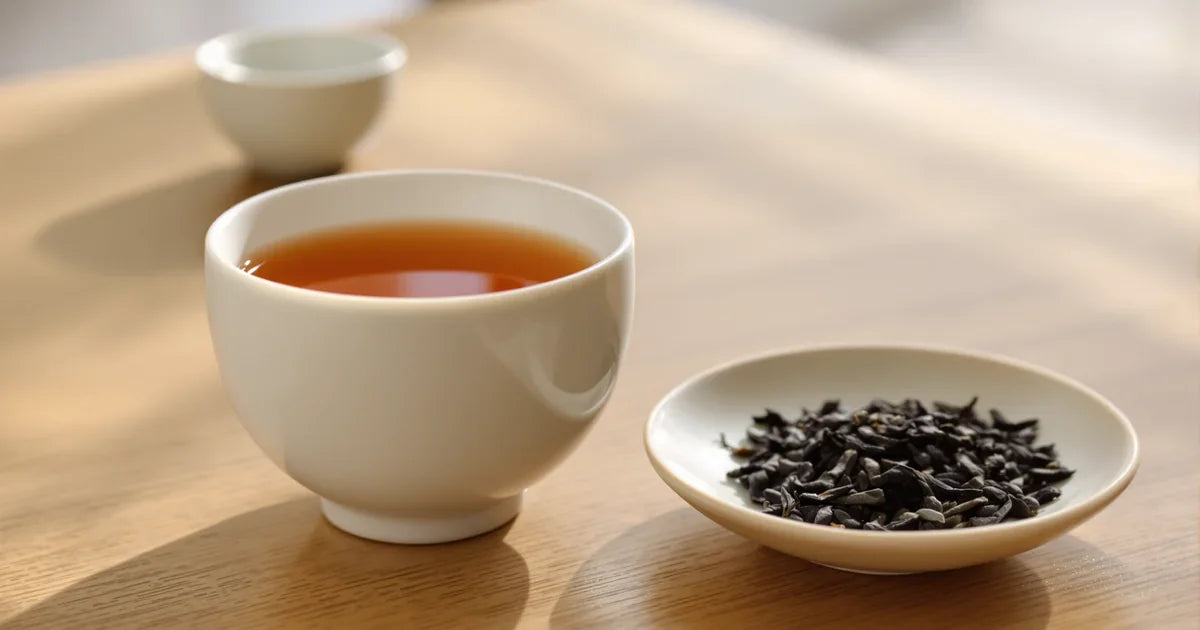
The astringency is low. This is the most surprising characteristic for people approaching Izumi from experience with commercial black teas. Where Darjeeling or Assam carry a brisk grip that is part of their appeal, Izumi is light and easy — more like a high-grade Japanese green tea in its gentleness on the palate, despite being fully oxidized. The color of the liquor is typically amber, clear, bright — consistent with that name, "fountain."
Flavor varies by producer and growing season. Spring-picked Izumi tends toward more delicate floral notes; summer-picked shows more of the tropical fruit character; autumn can bring a slightly earthier, more complex quality. The cultivar is expressive enough that growing conditions and timing make a real difference in what appears in the cup.
Where the Izumi tea cultivar grows
Southern Shizuoka Prefecture — where winters are mild enough to support the cultivar's modest cold tolerance — is the main growing region for Izumi today. A small number of producers in Kyushu also grow it. The total cultivation area is extremely limited: this is not a cultivar that appears at scale anywhere. Individual farms, individual producers — the supply is limited to a handful of growers.
That scarcity makes Izumi tea genuinely difficult to find. Single-cultivar Izumi black tea is a specialty product even within the Japanese specialty tea market. When it appears at tea events or from importers who work directly with small Shizuoka producers, it tends to sell quickly. For more on Shizuoka's tea landscape, our article on Shizuoka's tea-growing region gives the full geography.
How to brew Izumi black tea
Use standard black tea parameters as a starting point: 90-95°C water, a 2-3 minute steep, and 3-4g per 200mL. But treat the short end of those ranges as the target rather than the long end. Izumi's delicate, floral character is easily overwhelmed by overextraction — a two-minute steep at 90°C captures the aromatic complexity without pushing the mild tannins into harshness.
Drink without milk to preserve the fruit and floral notes. Milk flattens exactly the qualities that make Izumi interesting. No sugar either, for the same reason. The cup is light enough that additional flavoring only obscures the cultivar character you are paying for. For context on how to approach Japanese black teas generally, our article on oxidized teas covers the category in more detail.
The Izumi tea cultivar represents a path that Japanese tea nearly abandoned and then quietly preserved. Its near-disappearance was not a failure of the cultivar — the cup is too good for that explanation. It was a casualty of agricultural economics and shifting export markets. The producers who kept growing it understood something about what it could offer, and that preservation has kept a genuinely unusual tea in the world.
If you want to explore Japanese teas beyond the mainstream, including cultivar-specific and specialty selections when available, you can browse our tea collection.
Frequently Asked Questions
Is Izumi a green tea cultivar or a black tea cultivar?
Izumi is a cultivar, not a processing style. It was registered in 1960 for pan-fired tamaryokucha, but today producers also use it for delicate Japanese black tea.
What is Izumi's parent cultivar lineage?
Izumi was selected from a Benihomare seedling. Benihomare has black tea heritage, which helps explain Izumi's unusual fit for oxidized processing in Japanese tea.
How should we brew Izumi black tea?
Start with 3-4g per 200mL, 90-95°C water, and 2-3 minutes. We prefer the short end: about 2 minutes at 90°C keeps the floral aroma clear.
How does Izumi taste compared with Assam or Darjeeling?
Izumi is light and low in astringency compared with the brisk grip of Assam or Darjeeling. It is delicate and floral, with mango and orange notes and sometimes a clean, almost minty freshness.
Why is Izumi so hard to find?
Izumi nearly disappeared after Japan's black tea export market collapsed. Today only a few growers, mainly in southern Shizuoka and some in Kyushu, keep it alive.
How does Izumi bridge green and black tea heritage?
Izumi was selected from a Benihomare seedling and registered for pan-fired tamaryokucha, a green tea style. Benihomare has black tea heritage, and producers also use Izumi for distinctive Japanese black tea with a delicate flavor and low astringency.